

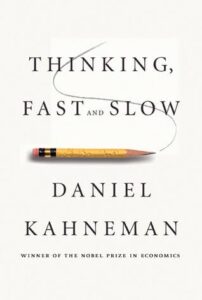
| Title | Thinking Fast and Slow Summary |
|---|---|
| Author Name | Daniel Kahneman |
| Type | Non-Fiction |
| Published | 2011 |
| Number of Copies Sold | More than 2.6 million copies |
| Online | Available online as an eBook and audiobook |
Thinking Fast and Slow by Daniel Kahneman is one of the most influential books on human decision-making and behavioural psychology. Written by Nobel Prize-winning psychologist Daniel Kahneman, the book explores how our minds work through two different systems of thinking, and why we often make irrational choices without even realizing it. With its groundbreaking research and relatable examples, this book has changed how millions of people understand their own thought process.
More Books
- The 4-Hour Workweek By Tim Ferriss
- Rich Dad Poor Dad By Robert T. Kiyosaki
- Made in America By Sam Walton
Interesting Fact About Book
An interesting fact about this book is that Daniel Kahneman won the Nobel Prize in Economic Sciences in 2002, even though he was a psychologist, not an economist. His research with Amos Tversky on decision-making under uncertainty laid the foundation for the entire field of behavioral economics.
Best Quote from the Book
One memorable idea associated with the book is:
“Nothing in life is as important as you think it is while you are thinking about it.”
This powerful message highlights how our minds often exaggerate the importance of whatever we’re currently focused on.
Summary By Daniel Kahneman
The book explains how two different systems in our brain control the way we think, judge, and make decisions. Kahneman introduces these as System 1 and System 2, and shows how understanding them can help us recognize our own biases and make better choices.
The main purpose is not simply to explain psychology. Instead, the book encourages readers to become more aware of when their fast, automatic thinking might be leading them astray.
What Are System 1 and System 2?
System 1 – Fast, intuitive, automatic, and emotional. It works without effort and handles everyday decisions instantly.
System 2 – Slow, deliberate, logical, and effortful. It takes over for complex problems that require careful reasoning.
These two systems constantly interact, and most of our daily decisions are actually made by System 1, often without us noticing.
System 1: Fast and Automatic Thinking
System 1 operates quickly and effortlessly. It is responsible for things like recognizing a face, reacting to a loud noise, or completing simple phrases. While System 1 is efficient, it is also prone to biases and shortcuts, known as heuristics, which can lead to predictable errors in judgment.
System 2: Slow and Deliberate Thinking
System 2 requires focus and mental effort. It is used for tasks like solving a math problem, comparing two products before buying, or filling out a complex form.Because System 2 is effortful, the brain often prefers to let System 1 handle things whenever possible even when a situation actually calls for careful analysis.
Cognitive Biases and Heuristics
A major part of the book explores the mental shortcuts our brains take, and how they can distort our judgment. Some key biases Kahneman discusses include:
- Anchoring – relying too heavily on the first piece of information we receive
- Availability Heuristic – judging likelihood based on how easily examples come to mind
- Loss Aversion – feeling the pain of losses more strongly than the pleasure of gains
- Overconfidence – trusting our judgments more than the evidence supports
The Concept of Loss Aversion
One of Kahneman’s most well-known contributions is the idea of loss aversion the tendency for people to prefer avoiding losses over acquiring equivalent gains.This concept explains why people often make overly cautious or irrational financial and life decisions, even when the odds are in their favour.
Why Is This Book Popular?
This remains popular because its ideas are backed by decades of research yet explained in an accessible way.
It is popular because it:
- Explains real scientific research in simple terms
- Helps readers understand their own decision-making
- Reveals hidden biases in everyday thinking
- Combines psychology with practical life lessons
- Encourages more rational and reflective choices
- Applies to business, finance, and personal life
- Has shaped modern fields like behavioral economics
The book has become especially appealing to people who want to understand why they (and others) sometimes make illogical decisions.
Key Lessons from Thinking, Fast and Slow By Daniel Kahneman
Slow Down for Important Decisions: Important choices deserve deliberate System 2 thinking, not quick System 1 reactions.
Recognize Your Biases: Being aware of common mental shortcuts can help you avoid predictable errors.
Losses Hurt More Than Gains Feel Good: Understanding loss aversion can lead to smarter financial and life decisions.
Don’t Trust Confidence Alone: Confidence doesn’t always mean accuracy question your own certainty.
Context Shapes Judgment: The way information is presented (framing) can heavily influence decisions.
Why Should You Read ?
This book is perfect for:
- People interested in psychology and human behaviour
- Professionals who make frequent business or financial decisions
- Students of economics, marketing, or decision science
- Readers interested in self-awareness and critical thinking
- Anyone who wants to understand why people make irrational choices
The ideas are particularly useful for readers who want to make more thoughtful decisions and avoid common mental traps.
FAQs
What is Thinking, Fast and Slow by Daniel Kahneman about?
The book is about the two systems that drive human thinking fast, intuitive judgments and slow, deliberate reasoning and how they shape our decisions.
Who wrote this book?
The book was written by Daniel Kahneman, a psychologist and Nobel Prize-winning researcher in behavioral economics.
What do System 1 and System 2 mean?
System 1 is fast, automatic, and intuitive thinking. System 2 is slow, effortful, and logical thinking.
What is the main message of this book?
The main message is that understanding how our minds think can help us recognize biases and make more rational decisions.
Is Thinking, Fast and Slow a difficult book to read?
It can be dense in places due to its research-based content, but Kahneman uses relatable examples to make the ideas easier to understand.
Conclusion
Thinking, Fast and Slow by Daniel Kahneman is a thought-provoking book that reveals the hidden mechanics behind human decision-making. Through the exploration of System 1 and System 2 thinking, readers can better understand their own biases, judgments, and choices. The book’s greatest lesson is that awareness of how we think is the first step toward thinking better.